

 Tiếng Việt
⚖️ Decree No. 20/2026/NĐ-CP introduces a comprehensive package of tax incentives, including:
▪️ Corporate Income Tax (CIT) exemption and reduction for innovative startups, venture capital fund management companies, and innovation intermediaries;
▪️ CIT / Personal Income Tax (PIT) exemption for income derived from the transfer of shares, capital contributions, or investment rights in innovative startups;
▪️ 03-year CIT exemption for newly established small and medium-sized enterprises (SMEs);
▪️ PIT exemption and reduction for experts and scientists working for innovative startups, R&D centers, and innovation-supporting organizations.
📉 These incentives directly target early-stage financial pressure, capital mobility, and talent attraction within the private sector.
❓ But what legal conditions accompany these incentives?
⚠️ Tax incentives under Decree 20/2026/NĐ-CP are compliance-driven
The Decree does not treat tax incentives as automatic entitlements. Instead, it requires enterprises to observe strict legal discipline, including:
🔹Separate accounting for income eligible for tax incentives and non-eligible income;
🔹Consistent application of the selected incentive regime throughout the incentive period;
🔹Accurate qualification of beneficiaries, based on sector-specific laws on startups, SMEs, science and innovation;
🔹Repayment of tax benefits and late-payment interest if enterprises are later found ineligible following inspection or audit.
📌 Tax incentives therefore operate as a long-term legal commitment, not merely a short-term cost-saving measure.
🏗️ Tax incentives within a broader legal framework
Tax support under Decree 20/2026/NĐ-CP is part of a coherent policy architecture, combined with:
🔹Preferential access to land in industrial zones, clusters, and technology incubators;
🔹Refund mechanisms for reduced land rental;
🔹Preferential leasing of public land and assets;
🔹Support for R&D, innovation, digital transformation, and workforce training.
👉 This integrated approach reflects a shift from isolated incentives to structured, enforceable support mechanisms for private enterprises.
📎 Legal Perspective from THE LAM LAW LLC – Your legal need, Our Mission
From a legal advisory standpoint, the true value of tax incentives under Decree 20/2026/NĐ-CP lies not in the incentive rates themselves, but in how enterprises design their legal structure and compliance framework from the outset.
Misclassification, improper timing, or weak accounting discipline may ultimately neutralize the intended tax benefits.
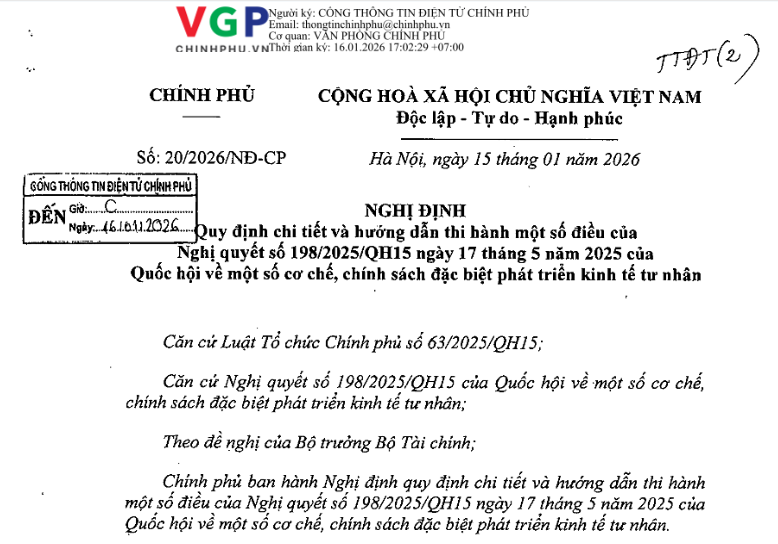
📎 Reference – Decree No. 20/2026/NĐ-CP
THE LAM LAW LLC
🏢Indochina Park Tower, # 4 Nguyen Dinh Chieu Str, Tan Dinh Ward, Ho Chi Minh City.
📞Tel: +84 (0)28 710 58 222 – 6288 3798 – Hotline: +84 (0) 973 097 777
✉ Email: info@thelamlawllc.com





Related Posts
Happy Vietnamese Lawyer’s Traditional Day
💖 Warmest congratulations on the 81th Anniversary of Vietnam Lawyers’ Traditional Day (October 10, 1945
Oct
Supporting the Next Generation of Legal Professionals – VMOOT 2026
THE LAM LAW – Your legal need, Our Mission was honoured to support VMoot2026, the
Oct
THE LAM joins V-MED 2026
On 26–27 September 2026, the Final Round of the Vietnam Mediation Moot (V-MED 2026) was
Sep
Strengthening Connections, Building Trust & Creating Business Opportunities
Yesterday morning, September 22, 2026, THE LAM LAW – Your legal need, Our Mission was
Sep
Internal Training – Civil status data special Topic
As public administration continues to shift from a “document presentation” model to a “data-driven” approach,
Sep
Team Building 2026 – Together, We Go Further
✨ Recently, the THE LAM team embarked on a memorable 3-day, 2-night team-building trip to
Sep