

 Tiếng Việt
In the insurance industry, disputes often arise not because a loss has not occurred, but because uncertainty remains regarding who caused it.
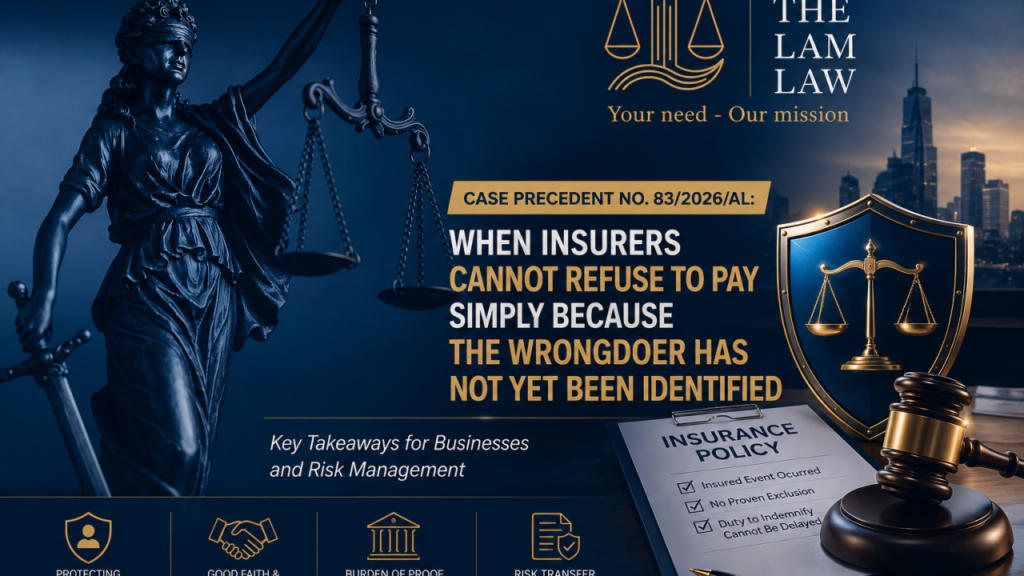
A recent Vietnamese precedent, Case Precedent No. 83/2026/AL, addresses a critical question:
Can an insurer refuse or indefinitely delay payment under an insurance policy merely because authorities have not yet identified the person responsible for the damage?
The answer provided by the Supreme People’s Court is both clear and impactful: No.
This precedent is likely to influence future disputes involving property insurance, motor vehicle insurance, construction all-risk insurance, and other commercial insurance products.
The Facts Behind the Case
The insured purchased comprehensive motor vehicle insurance for a Ford Ranger.
During the policy period, the vehicle was completely destroyed by fire.
A forensic investigation concluded that:
- The fire was caused by human intervention;
- The incident appeared to involve intentional destruction of property;
- However, the authorities could not determine who committed the act.
As a result, the criminal investigation was suspended.
The insurer subsequently denied the claim, arguing that the cause and responsible party had not been fully determined and that it was therefore impossible to conclude whether policy exclusions might apply.
The dispute eventually reached the courts and became the basis for Case Precedent No. 83/2026/AL.
The Court’s Legal Reasoning
What makes this precedent significant is not merely the outcome, but the legal principles applied by the Court.
1. Separating Insurance Liability from Criminal Liability
The Court drew a clear distinction between:
- The occurrence of an insured event; and
- The outcome of a criminal investigation.
The Court found that:
✅ The insurance contract was valid.
✅ The fire occurred during the policy period.
✅ Actual loss was suffered.
✅ The insured had complied with policy requirements.
Therefore, the insured event had already occurred.
Whether law enforcement could identify the perpetrator was a separate issue and should not prevent the insurance contract from functioning as intended.
This approach prevents policyholders from being left in legal limbo while criminal investigations remain unresolved for months or even years.
2. Exclusion Clauses Cannot Be Based on Speculation
One of the fundamental principles of insurance law is that exclusions must be interpreted narrowly.
The insurer argued that intentional destruction could potentially fall within an exclusion.
However, the Court emphasized that:
There was no evidence demonstrating that the insured or any beneficiary intentionally caused the loss.
The mere existence of suspicion was insufficient.
Importantly, the Court reaffirmed that:
The burden of proving an exclusion rests with the insurer.
Policyholders should not be required to prove the absence of wrongdoing.
3. Insurance Exists to Transfer Risk, Not Postpone It
Perhaps the most important message from the precedent is conceptual rather than procedural.
Insurance is designed to transfer risk from the insured to the insurer.
If insurers could simply respond to every uncertain case by saying:
“Let’s wait until the investigation is complete,”
the commercial purpose of insurance would be significantly undermined.
The Court recognized that uncertainty in a criminal investigation cannot automatically justify postponing contractual obligations.
Where no exclusion has been proven, the insurer must honor its promise to indemnify the insured.
4. The Insurer’s Rights Remain Protected
The decision does not leave insurers without remedies.
The Court acknowledged that after making payment, the insurer may still:
✔ Exercise subrogation rights against the wrongdoer;
✔ Seek reimbursement from responsible third parties once identified;
✔ Recover payments if subsequent evidence reveals fraud or intentional misconduct by the insured.
In other words, the Court did not eliminate the insurer’s legal protections.
It simply refused to shift the entire burden of investigative uncertainty onto the policyholder.
Why This Precedent Matters for Businesses
The significance of Case Precedent No. 83/2026/AL extends far beyond motor vehicle insurance.
Its reasoning may influence disputes involving:
🏗 Construction All-Risk (CAR) Insurance
🏭 Industrial Property Insurance
🔥 Fire and Explosion Insurance
⚙ Machinery and Equipment Insurance
🚢 Marine Cargo and Logistics Insurance
As Vietnam continues to expand its infrastructure, energy, manufacturing, and real estate sectors, disputes involving unexplained damage, sabotage, and unidentified third-party actions are becoming increasingly common.
This precedent provides valuable guidance on how such risks should be allocated between insurers and policyholders.
THE LAM LAW – Your legal need, Our Mission’s Perspective
From THE LAM LAW’s perspective, the most important contribution of Case Precedent No. 83/2026/AL is the Court’s commitment to preserving the commercial purpose of insurance contracts.
The decision sends a powerful message:
An insurer cannot rely on investigative uncertainty as a basis for indefinitely delaying its contractual obligations.
The precedent reinforces legal certainty, protects legitimate expectations of policyholders, and promotes confidence in Vietnam’s insurance market.
For businesses, it also serves as an important reminder that effective risk management does not end with purchasing insurance.
Maintaining proper documentation, preserving evidence, and complying with notification requirements remain critical factors in successfully enforcing insurance rights when disputes arise.
Final Thoughts
Risk itself is not the greatest threat to a business.
The greater threat arises when a protection mechanism that was specifically purchased to manage that risk fails to operate when it is needed most.
Case Precedent No. 83/2026/AL represents an important step toward ensuring that insurance contracts deliver the protection they promise.
And that may ultimately be the most valuable precedent of all.
⚠️ Disclaimer: This publication is provided for general information and knowledge-sharing purposes only. It does not constitute legal advice, legal opinion, or professional recommendation. Readers should seek independent legal advice tailored to their specific circumstances before taking or refraining from any action based on the information contained herein. THE LAM LAW LLC and its members disclaim any liability arising from the use of this publication without obtaining specific legal consultation.
🤝 If you have any questions regarding this Case Precedent, insurance disputes, commercial litigation, arbitration, or require tailored legal advice, please do not hesitate to contact our team at THE LAM LAW LLC.
THE LAM LAW LLC
🏢 26/5 Nguyen Binh Khiem Street, Tan Dinh Ward, Ho Chi Minh City.
📞Tel: +84 (0)28 710 58 222 – 6288 3798 – Hotline: +84 (0) 973 097 777
✉ Email: info@thelamlawllc.com





Related Posts
THE LAM LAW – Notable Firm in the Asialaw 2026 Rankings.
🏆 A milestone for our firm. A shared achievement with those who trust us.THE LAM
Oct
Happy Vietnamese Women’s Day
On the occasion of Vietnamese Women’s Day, THE LAM wishes all women, female Lawyer &
Oct
Happy Vietnamese Lawyer’s Traditional Day
💖 Warmest congratulations on the 81th Anniversary of Vietnam Lawyers’ Traditional Day (October 10, 1945
Oct
Supporting the Next Generation of Legal Professionals – VMOOT 2026
THE LAM LAW – Your legal need, Our Mission was honoured to support VMoot2026, the
Oct
THE LAM joins V-MED 2026
On 26–27 September 2026, the Final Round of the Vietnam Mediation Moot (V-MED 2026) was
Sep
Strengthening Connections, Building Trust & Creating Business Opportunities
Yesterday morning, September 22, 2026, THE LAM LAW – Your legal need, Our Mission was
Sep